Bluesphere Digital — SaaS studio for founders. Your Technical Co-Founder
Bluesphere Digital is a SaaS studio that acts as an outsourced technical co-founder for founders building software products.
We run three engagement types: a one-week Discovery Sprint, a production MVP build that ships in 8–12 weeks, and an ongoing fractional-CTO retainer. Clients own 100% of the code and intellectual property from day one, and we do not require equity. We work remotely from Australia with founders worldwide.
The Problem
Building SaaS fails at execution, not at the idea. These are the three failures that consume the most founder capital.
Unclear Scope
Vague requirements are the most expensive thing a founder can start with.
Without a written scope, every conversation reopens a decision that was already made, revisions multiply, and the budget goes on renegotiation rather than software. The failure is rarely the developers — it is that nobody agreed in writing what “done” meant before work started.
A one-week Discovery Sprint closes that gap by producing a prioritised MVP scope naming what ships and what does not, so the build has a fixed target. Scoping is cheap; renegotiating a half-built product is not.
Overbuilt MVPs
Most failed MVPs are not under-built, they are over-built.
Teams ship a dozen features before validating the one that matters. Months go on admin panels and settings screens no user asked for. The runway that should have funded the second iteration is gone. The core question — will anyone use this — stays unanswered while the product keeps growing.
The fix is to define the smallest product that answers that question honestly, ship it, and let real usage decide what gets built next. Every feature removed is a week of runway returned.
Unreliable Teams & Wasted Capital
Code that breaks, gets rebuilt, and breaks again is the most common way early-stage capital disappears.
It usually starts with the cheapest quote: an agency that under-delivers, a rotating cast of contractors with no continuity, or a build with no tests, no CI and no architecture behind it. The rebuild costs more than doing it properly would have, and it costs months as well as money.
Continuity of the people making decisions is what prevents it — which is why we work as long-term partners rather than interchangeable capacity.
What We Do
End-to-end SaaS engineering, from validating the idea to running it in production.
Idea Validation & MVP Scoping
A fixed-scope, one-week Discovery Sprint that ends with four artefacts rather than a proposal.
- A validated problem statement: who has it, how they solve it today.
- A prioritised MVP scope, naming what ships and what does not.
- A technical architecture: data model, integrations, hosting, AI.
- A working proof-of-concept you can click through.
You leave with a costed build timeline and own everything produced, including the proof-of-concept code, whether or not you go on to a full build.
Production-Grade MVP Builds
A validated scope turned into software running in production, typically in 8 to 12 weeks from kickoff.
Fixed scope with milestone-based delivery: each milestone ends in a working demo you can use yourself, and payment is released against accepted work rather than hours logged.
The code is written to be extended: typed, tested where behaviour matters, deployed through CI. The data model is chosen for the product you intend to have in three years. That is the difference between an MVP and a prototype.
You own 100% of the code and IP from the first commit, with full repository access throughout.
AI Integration & Tech Leadership
The two things founders most often need after launch: AI features that hold up with real users, and senior technical judgement without a full-time CTO hire.
On the AI side: retrieval-augmented generation, document intelligence and agent workflows, on OpenAI, Anthropic, Google or open-source models. Each ships with an evaluation set of real inputs and known-correct outputs — the same practice we run in production on ProfileIQ.
On the leadership side, architecture ownership, technology and vendor selection, delivery oversight, technical due diligence for fundraising, and input on your first engineering hires. Both run month to month.
Our Model
Your technical co-founder alternative: a three-phase path from idea to a product running in production, with a decision point at the end of each phase.
Discovery Sprint
MVP Build
Ongoing Retainer
Work
ProfileIQ is our own product, shown end to end. Client engagements are under NDA and are not described on this site — instead we publish engineering notes on how we build the systems we are asked about most.
ProfileIQ
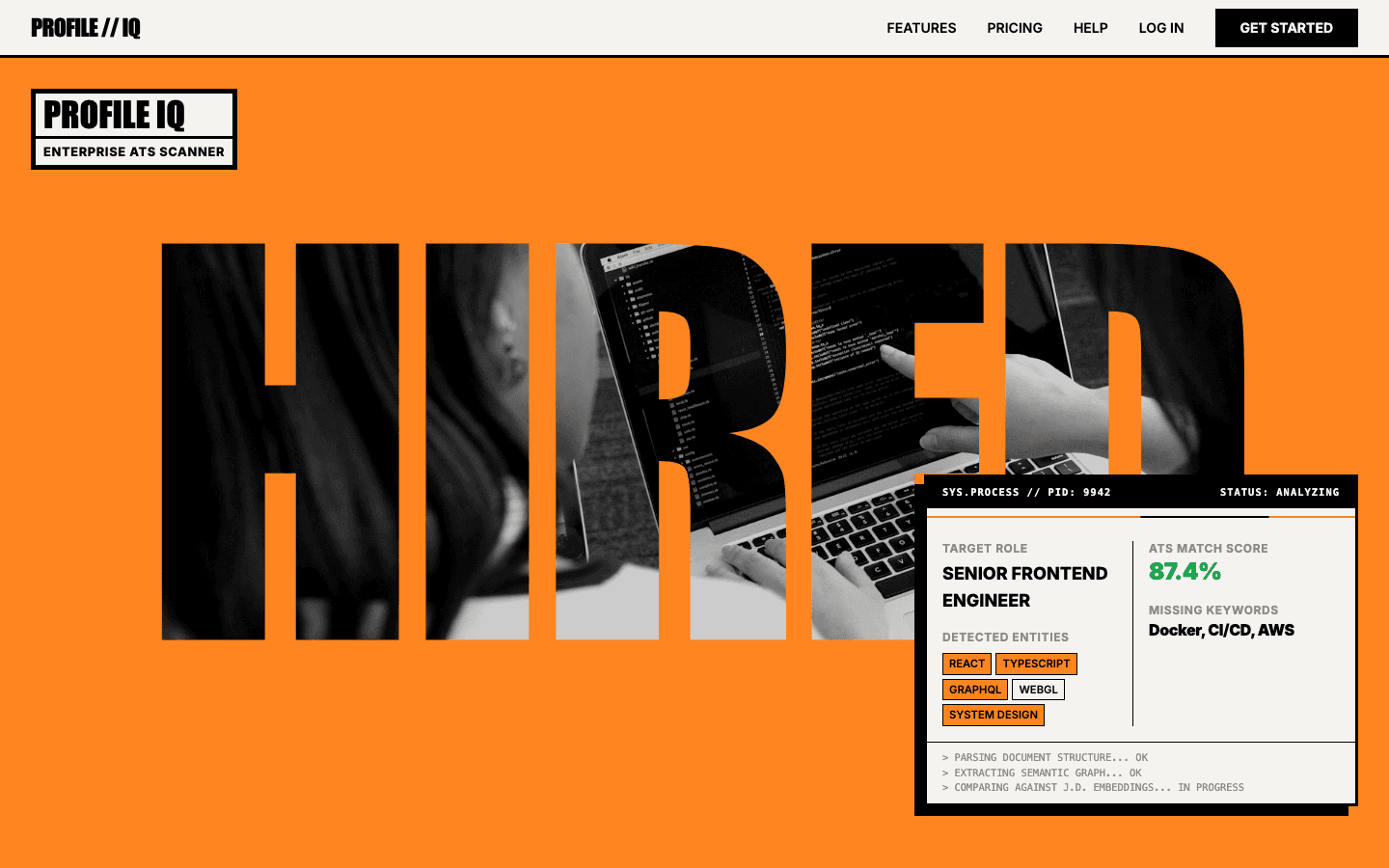
Our own SaaS product, live at profileiq.ai: AI resume intelligence for job seekers and recruiters.
We took it from concept through problem validation, architecture, build and launch, and we run it in production today. That means we carry the same on-call, cost and reliability decisions we ask clients to make.
If you want to see how Bluesphere Digital builds, use the product.
NDA Review Agents
How we approach AI systems that read incoming non-disclosure agreements and report deviations from a written playbook in minutes rather than days.
The decision is always left to a human reviewer. The note covers why the agent pattern earns its place, why the two failure modes are not symmetric, and why most of the reliability comes from the layers around the model rather than the model itself.
It generalises to any process where trained people apply a documented policy to inconsistent documents at volume.
Structured Finance Platforms
How we approach platforms that turn inconsistent deal data into verified investor documents.
Structured finance still runs largely on manual document production. Numbers move between spreadsheets, analysts and Word templates for days per deal, and every re-keying is a chance for two documents describing the same deal to disagree.
- Normalise inbound data ruthlessly at the boundary.
- Refuse to guess.
- Keep the verification layer deterministic and testable.
- Generate every document from one verified record.
Who We Work With
Serious founders only. We focus on deeply strategic work — not quick hack builds. See the full fit criteria.
System Specs
The stack we build on, and the terms every engagement runs under.
Bluesphere Digital builds on a standard, boring production stack, chosen per product rather than applied from a template.
The default starting point for a SaaS MVP is TypeScript with React and Next.js on the front end, Node.js or Python on the back end, PostgreSQL for data, and deployment to Vercel or AWS behind CI. That combination reaches market fastest and is the easiest stack to hire into later.
AI features run on OpenAI, Anthropic Claude, Google Gemini or open-source models, chosen on cost, speed and where the data is allowed to go. If your product already runs on something else, we work in it rather than proposing a rewrite.
Frequently Asked Questions
Every answer below is rendered in the page source — nothing is hidden behind a click.
Can I see examples of your work?
Yes. ProfileIQ, our own AI SaaS product, is live at profileiq.ai and you can use it today. It is the build we can show end to end: concept, architecture, launch, and day-to-day production. Client engagements are under NDA and are not described on this site — no names, no screenshots, no engagement details, and no phrasing designed to imply them.
What we publish instead are engineering notes on how we build the classes of system we are asked about most. We are happy to go deeper on a call, under your own NDA if you prefer.
What is a Discovery Sprint?
A Discovery Sprint is a fixed-scope, one-week engagement. It ends with four artefacts rather than a proposal: a validated problem statement, a prioritised MVP scope, a technical architecture, and a working proof-of-concept you can click through. It answers whether an idea is worth building before anyone commits to an 8-12 week build.
You also receive a costed build timeline, so the decision to proceed is made against a real plan instead of an estimate. Founders who stop after the sprint still own everything produced during it, including the proof-of-concept code.
How long does it take to build an MVP?
A Bluesphere Digital MVP build typically ships in 8 to 12 weeks from kickoff to launch. The build is fixed scope with milestone-based delivery. Every milestone ends in a working demo you can use yourself, not a status report, and payment is released against accepted work rather than hours logged.
Where a project lands in that range depends on how settled the scope is before the build starts — which is what the one-week Discovery Sprint resolves. Builds that begin with an unvalidated scope take longer, because the scope gets renegotiated mid-build.
What tech stack do you use?
Bluesphere Digital is deliberately stack-agnostic. The right tools depend on what you are building, your team, and where you want to be in three years. Our default for most SaaS products is TypeScript with React and Next.js, Node.js or Python on the backend, and PostgreSQL. That combination gets founders to market fastest and is the easiest stack to hire into later. Beyond it we work across Python, Go and .NET, React Native and Flutter for mobile, and SQL, NoSQL and vector databases.
We build event-driven and serverless architectures, deployed to AWS, GCP, Azure or Vercel. AI features run on OpenAI, Anthropic, Google or open-source models. If your product needs a different stack, or you already have one, we work in it rather than proposing a rewrite.
Who owns the code and intellectual property?
You own 100% of the code and intellectual property from day one — not at handover, and not after final payment. Source code, designs, documentation and infrastructure configuration all belong to you. You have full repository access throughout the build, so you can read every commit as it lands.
There is no proprietary framework to license from us afterwards, and nothing that makes moving to another engineering team expensive. If an engagement ends early, everything built up to that point is still yours.
How do payments work?
MVP builds are fixed scope with milestone-based payments. The scope and the milestones are agreed before the build starts. Each milestone ends in a working demo you can use, and payment is released against delivered and accepted work. There is no open-ended hourly billing and no time-and-materials drift.
Ongoing retainers run month to month at an agreed monthly rate. Because the scope is fixed up front, the number you budget at kickoff is the number you pay at launch — unless you choose to change the scope.
Do you take equity in projects?
Only where there is genuine alignment, and always alongside development fees rather than instead of them. We take a minority position when we expect to be involved with the product well beyond the initial build, and want a share in the long-term upside.
Equity is never a requirement. The standard engagements are a fixed-scope Discovery Sprint, a fixed-scope MVP build, and a monthly retainer, all paid in cash. Founders who would rather keep their cap table clean are not treated differently.
What does a fractional CTO do?
A fractional CTO provides senior technical leadership part-time. It suits founders who need the judgement of a CTO but do not yet need — or cannot yet fund — a full-time hire. In practice that covers architecture decisions and their trade-offs, technology and vendor selection, delivery planning and oversight, and technical due diligence during fundraising.
It also covers interviewing and onboarding the first engineers, and hands-on development where it unblocks the product. At Bluesphere Digital it runs as a month-to-month retainer, usually after an MVP build, so the person making architecture decisions is the person who wrote it.
Who is the ideal client for Bluesphere Digital?
Bluesphere Digital works best with three kinds of client. Non-technical founders with deep domain expertise who need a technical counterpart to turn it into software. Established businesses productising an internal tool into a SaaS product. And teams that need senior technical leadership without a full-time CTO hire.
The engagements we decline are equally specific: price-first procurement, staff augmentation where engineers are interchangeable capacity, and tactical fixes with no product strategy behind them. We work on strategic, long-term partnerships rather than quick hack builds.